
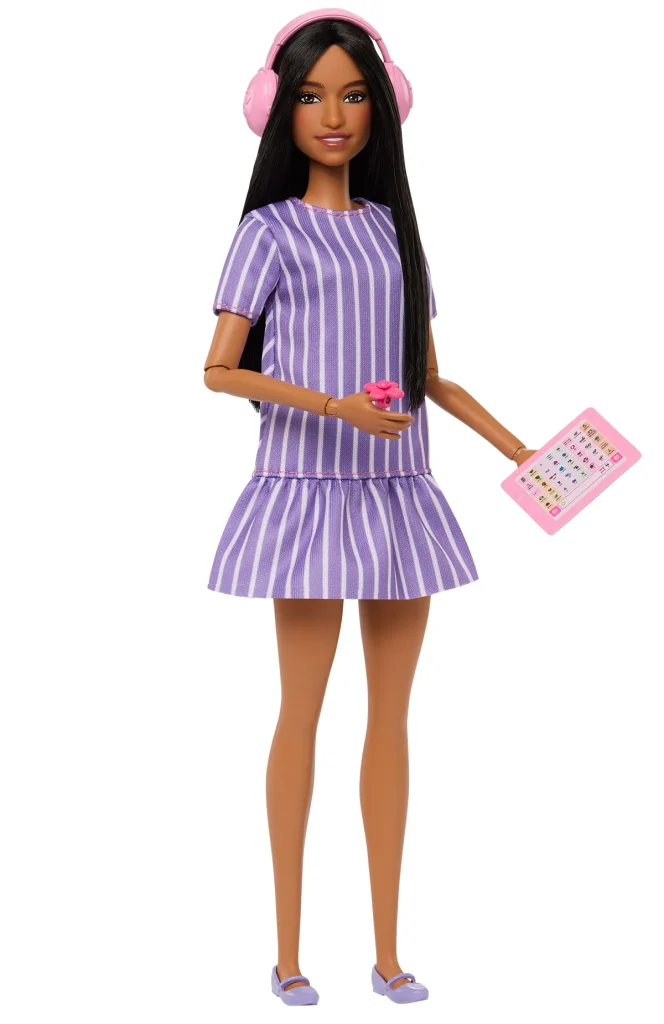
Earlier this month, Barbie released “the First Autistic Barbie Doll, Championing Representation for Children through Play.” This new Barbie was designed with elbow and wrist articulation, “enabling stimming, hand flapping, and other hand gestures.” The doll’s gaze is slightly to the side to mimic avoiding eye contact. It comes with a fidget spinner, sound-cancelling headphones, and a tablet with Augmentative and Alternative Communication apps, and wears “sensory-sensitive fashions.”
Families across the LLC community and communities in general are actively responding—some with excitement, others with thoughtful concern—because this conversation reflects lived experience, not abstract debate. Parents know firsthand that autism is not a single presentation, a checklist of traits, or a visible identity that can be reliably “seen.” Our children are children first: individuals with unique personalities, strengths, challenges, interests, and ways of engaging with the world. For many families, the use of person-first language is intentional and meaningful because it reinforces that autism is one part of a person, not the totality of who they are. From a parent perspective, the appeal of this Barbie is understandable. Representation can open doors to conversation, normalize supports such as noise-canceling headphones or communication devices, and send a message that accommodations are not something to hide.
Many families have shared that seeing a doll with tools their child may use feels validating and creates opportunities to educate siblings, peers, and educators about inclusion and acceptance. At the same time, families are also expressing concern—particularly around language and framing. Referring to the doll as “Autistic Barbie,” rather than a “Barbie with Autism,” is controversial for many parents. That distinction matters. Labeling the doll in this way could present autism as the defining characteristic, rather than one aspect of a whole person. Families worry this reinforces the idea that a diagnosis is the headline, rather than recognizing the individual first.
There is also a broader concern about the implication that autism can be visually defined. Autism is not visible and cannot be accurately captured by a specific look, set of accessories, or
behaviors. Some children stim; others do not. Some avoid eye contact; others seek it. Some use augmentative and alternative communication; many do not. Sensory tools are widely used by people who are not autistic. When a single image is presented as representative, families worry it may unintentionally create narrow expectations that do not reflect the diversity of real children and adults.
For parents, this concern is not theoretical. Misunderstanding has real consequences. When Autism is reduced to a visual or linguistic stereotype, children who do not fit that image may be questioned, misunderstood, or denied needed support. Families spend years advocating for services and accommodations precisely because autism cannot be seen and should not have to be proven through appearance or labels.
Perhaps the most meaningful takeaway is the reminder that any Barbie can be a Barbie with Autism. That idea reflects how parents see their children every day: whole people first, with autism being one part of who they are, not the defining feature. True inclusion leaves space for the full range of human experience and honors individuality, rather than prescribing what autism is supposed to look like.